VIN Decoder: How to Decode Any Vehicle Identification Number
- What Is a VIN Decoder?
- How Is a VIN Structured?
- What Do the 17 Digits in a VIN Mean?
- Where Can You Find a VIN on a Vehicle?
- How to Decode a VIN Step by Step
- Free vs. Paid VIN Decoder Tools: What’s the Difference?
- Why Should You Decode a VIN Before Buying a Used Car?
- What Are Common VIN Decoder Mistakes to Avoid?
- Frequently Asked Questions
Every vehicle on the road carries a unique 17-character code that tells its entire story — from the country where it was built to the exact assembly plant and production sequence. A VIN decoder is the key to unlocking all of that information in seconds.
Whether you’re buying a used car, verifying a vehicle’s history, or just curious about what those 17 characters mean, this guide breaks down exactly how to decode any Vehicle Identification Number like a pro.
According to the National Highway Traffic Safety Administration (NHTSA), every car, truck, SUV, and motorcycle manufactured after 1981 is assigned a standardized 17-character VIN. No two vehicles share the same VIN — it’s essentially a vehicle’s fingerprint.
What Is a VIN Decoder?
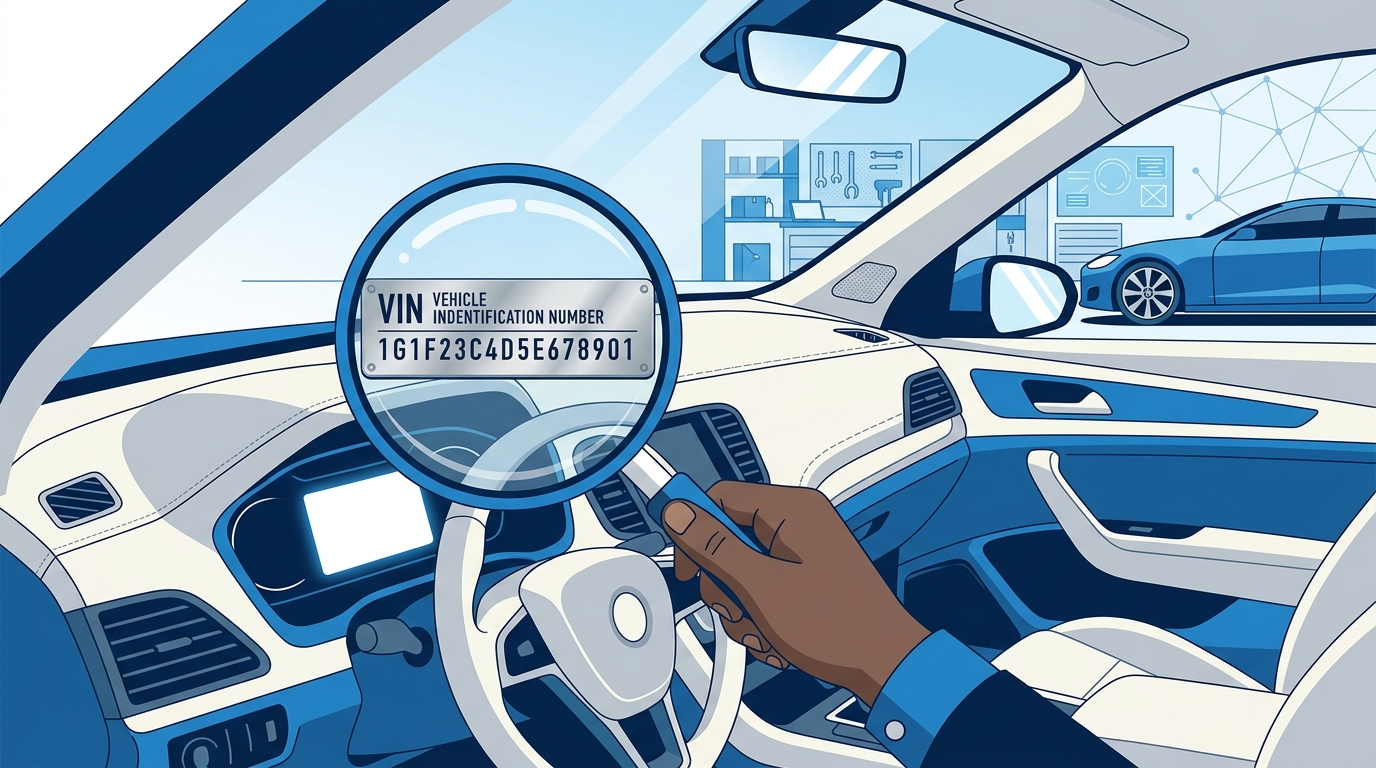
A VIN decoder is a tool that translates a vehicle’s 17-character Vehicle Identification Number into readable information about the car’s make, model, year, engine type, manufacturing plant, and more.
Think of it this way: the VIN is a coded message, and the decoder is the translator. Each character in the VIN represents a specific piece of data defined by international standards (ISO 3779 and ISO 3780).
VIN decoding isn’t just for car enthusiasts. It’s a critical tool for:
- Used car buyers — verify that a seller’s claims match the actual vehicle specs
- Insurance companies — confirm vehicle details for accurate policy pricing
- Mechanics — order the correct parts by confirming exact engine and trim configurations
- Law enforcement — identify stolen vehicles or detect VIN cloning fraud
How Is a VIN Structured?
A VIN isn’t a random string of characters. It follows a precise structure defined by the NHTSA and international standards. Every 17-character VIN is divided into three distinct sections:
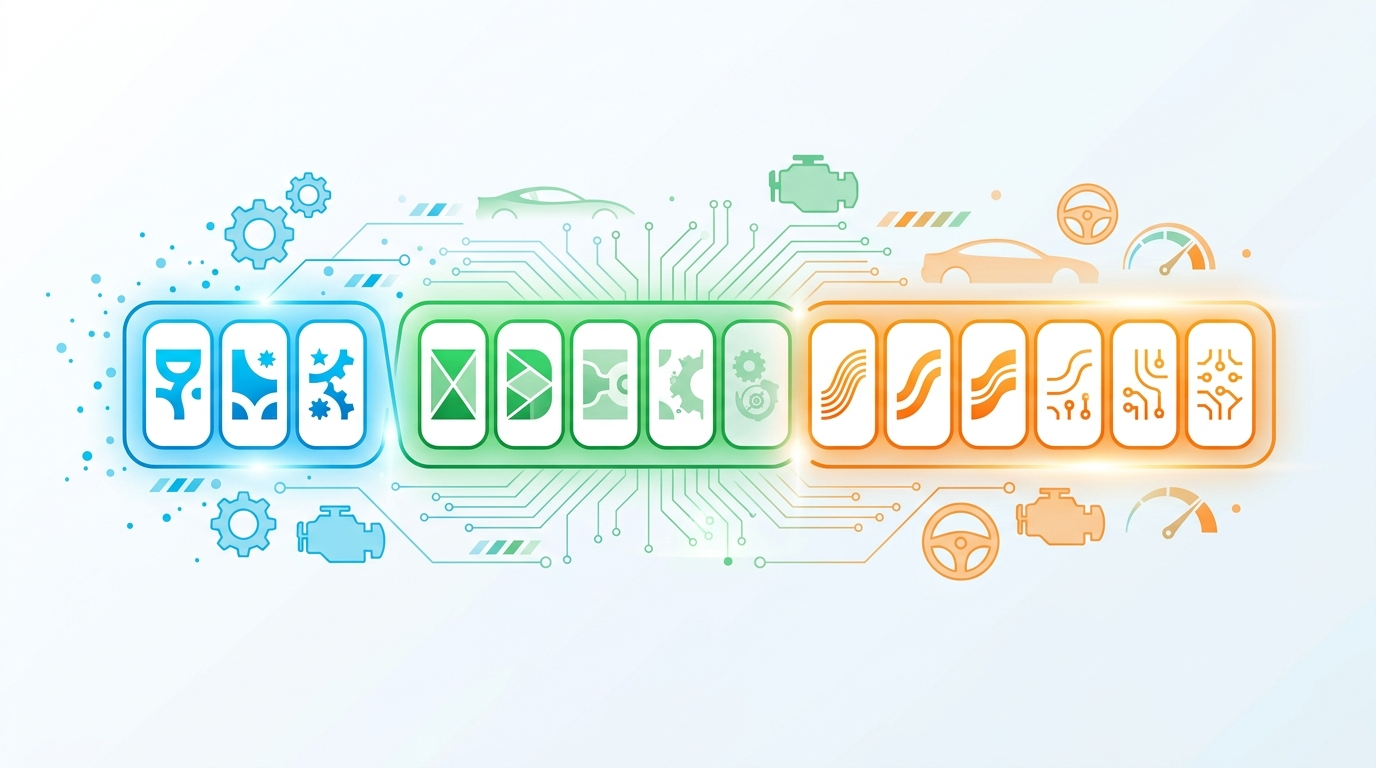
1. World Manufacturer Identifier (WMI) — Positions 1–3
The first three characters identify who made the vehicle and where. This section tells you the country of origin, the manufacturer, and the vehicle type or manufacturing division.
- Position 1 — Country of origin (e.g., 1 = USA, J = Japan, W = Germany, K = South Korea)
- Position 2 — Manufacturer (e.g., G = General Motors, T = Toyota, B = BMW)
- Position 3 — Vehicle type or manufacturing division (e.g., 1 = Chevrolet passenger car)
Example: A VIN starting with 1G1 means it’s a Chevrolet passenger car made in the USA by General Motors.
2. Vehicle Descriptor Section (VDS) — Positions 4–8
Characters 4 through 8 describe the vehicle’s specific attributes: body style, engine type, model, and restraint system. This is where you find the technical DNA of the car.
- Position 4 — Vehicle attributes (weight class, body type)
- Position 5 — Model or series
- Position 6 — Body style (sedan, coupe, SUV, etc.)
- Position 7 — Restraint system (airbag type, seatbelt configuration)
- Position 8 — Engine type (engine code identifying displacement, cylinders, fuel type)
Note: The exact meaning of positions 4–8 varies by manufacturer. Each automaker assigns these characters based on their own coding system, though all must comply with NHTSA regulations.
3. Vehicle Identifier Section (VIS) — Positions 9–17
The final nine characters provide unique identification for the specific vehicle, including the model year, assembly plant, and production sequence number.
- Position 9 — Check digit (a calculated value used to verify the VIN’s authenticity)
- Position 10 — Model year (e.g., R = 2024, S = 2025, T = 2026)
- Position 11 — Assembly plant code
- Positions 12–17 — Production sequence number (unique serial for that specific vehicle)
What Do the 17 Digits in a VIN Mean?
Let’s break down every single position in a VIN with a real-world reference. Here’s a complete character-by-character guide:
| Position | Section | What It Represents | Example |
|---|---|---|---|
| 1 | WMI | Country of manufacture | 1 = United States |
| 2 | WMI | Manufacturer | H = Honda |
| 3 | WMI | Vehicle type / division | G = Passenger car |
| 4 | VDS | Body type / weight class | Varies by maker |
| 5 | VDS | Model / series | Varies by maker |
| 6 | VDS | Body style | Sedan, coupe, SUV |
| 7 | VDS | Restraint system | Airbag configuration |
| 8 | VDS | Engine type | 2.0L Turbo, V6, EV |
| 9 | VIS | Check digit (validation) | 0–9 or X |
| 10 | VIS | Model year | T = 2026 |
| 11 | VIS | Assembly plant | Manufacturer-specific |
| 12–17 | VIS | Production sequence number | Unique serial |
VIN Model Year Codes (2020–2030)
One of the most useful parts of VIN decoding is identifying the model year. Here’s the current cycle:
| Code | Year | Code | Year |
|---|---|---|---|
| L | 2020 | R | 2024 |
| M | 2021 | S | 2025 |
| N | 2022 | T | 2026 |
| P | 2023 | V | 2027 |
Note: The letters I, O, Q, U, and Z are never used in VINs to avoid confusion with the numbers 0, 1, and 2.
Common Country of Origin Codes
| First Character | Country | First Character | Country |
|---|---|---|---|
| 1, 4, 5 | United States | W | Germany |
| 2 | Canada | S | United Kingdom |
| 3 | Mexico | Z | Italy |
| J | Japan | 9 | Brazil |
| K | South Korea | L | China |
Where Can You Find a VIN on a Vehicle?
Before you can decode a VIN, you need to find it. Every vehicle has the VIN stamped in multiple locations for identification and security purposes:

Most common VIN locations:
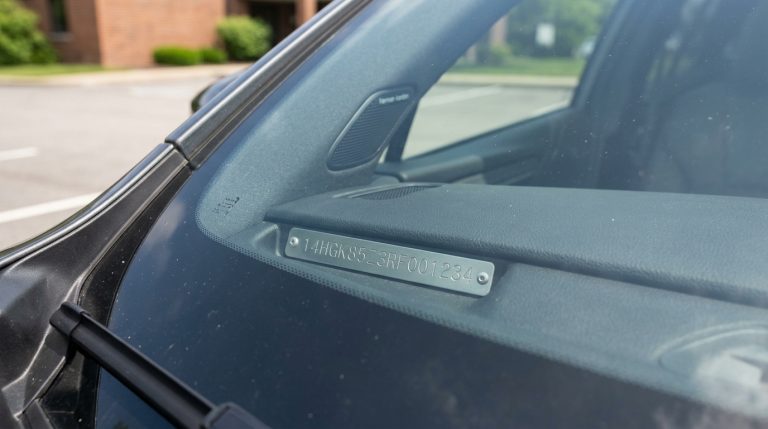
- Dashboard — Look through the windshield on the driver’s side, near the base of the windshield. This is the easiest spot to check without opening any doors.
- Driver’s side door jamb — Open the driver’s door and look for a sticker on the frame where the door latches. This sticker also shows tire pressure specs.
- Engine block — Stamped directly on the engine (usually on the front).
- Vehicle title and registration — Your state-issued title document includes the VIN.
- Insurance card — Your policy documents list the VIN for each covered vehicle.
Pro tip: When buying a used car, always compare the VIN on the dashboard with the VIN on the door jamb and the title. If any of them don’t match, walk away — it could indicate VIN cloning or tampering.
How to Decode a VIN Step by Step
Here’s exactly how to decode any VIN, whether you do it manually or use an online VIN decoder tool:

Method 1: Use NHTSA’s Free VIN Decoder
- Go to NHTSA’s VIN Decoder tool
- Enter the 17-character VIN
- Click “Decode VIN”
- Review the results: make, model, year, engine, body type, plant, and more
This is a great starting point, but NHTSA’s decoder only gives you manufacturing specs. It won’t tell you about accidents, title issues, recalls, or ownership history.
Method 2: Run a Full VIN Check with VINCheckup
For a complete picture, you need a VIN decoder combined with a vehicle history report. VINCheckup decodes the VIN and pulls data from the NMVTIS federal database to show:
- Full vehicle specifications (from VIN decoding)
- Accident and damage history
- Title brand records (salvage, rebuilt, flood, lemon)
- Odometer rollback alerts
- Theft records
- Recall information
- Ownership history
This is especially critical when buying a used car — the decoded specs only tell you what the car should be, while the history report tells you what actually happened to it.
Method 3: Decode a VIN Manually
You can decode most of a VIN by hand using the position guide above. Let’s walk through a real example:
Example VIN: 1HGBH41JXMN109186
- Position 1 (1) — Country: United States
- Position 2 (H) — Manufacturer: Honda
- Position 3 (G) — Vehicle type: Passenger car
- Positions 4–8 (BH41J) — Honda Civic, 4-door sedan, 1.5L engine
- Position 9 (X) — Check digit (validates the VIN is genuine)
- Position 10 (M) — Model year: 2021
- Position 11 (N) — Assembly plant: Greensburg, Indiana
- Positions 12–17 (109186) — Production sequence: 109,186th vehicle produced
In seconds, you’ve identified this as a 2021 Honda Civic sedan, built in Indiana, USA — all from 17 characters.
Free vs. Paid VIN Decoder Tools: What’s the Difference?
Not all VIN decoder tools are created equal. Here’s an honest comparison:
| Feature | Free VIN Decoders (NHTSA, etc.) | Paid VIN Check (VINCheckup) |
|---|---|---|
| Basic specs (make, model, year) | ✅ Yes | ✅ Yes |
| Engine & transmission details | ✅ Yes | ✅ Yes |
| Manufacturing plant | ✅ Yes | ✅ Yes |
| Safety equipment & features | ✅ Yes | ✅ Yes |
| Accident history | ❌ No | ✅ Yes |
| Title brand records | ❌ No | ✅ Yes (NMVTIS) |
| Odometer verification | ❌ No | ✅ Yes |
| Theft records | ❌ No | ✅ Yes |
| Open recall alerts | ✅ Partial | ✅ Yes |
| Market value estimate | ❌ No | ✅ Yes |
| Ownership history | ❌ No | ✅ Yes |
| Lien & loan records | ❌ No | ✅ Yes |
Bottom line: Free VIN decoders are great for quick spec lookups. But if you’re making a purchase decision, spending a few dollars on a comprehensive VINCheckup report can save you thousands by uncovering hidden damage, title issues, or odometer fraud.
Why Should You Decode a VIN Before Buying a Used Car?
According to Federal Trade Commission (FTC) data, odometer fraud alone costs American consumers over $1 billion annually. A quick VIN decode can help you avoid becoming part of that statistic.
Here are the top reasons to always decode a VIN before handing over your money:
1. Verify the Vehicle Is What the Seller Claims
Sellers sometimes misrepresent the year, trim level, or engine type of a vehicle. Decoding the VIN gives you the factory-verified specs — no guessing, no trusting someone’s word.
2. Spot Title Washing and VIN Cloning
Title washing is when a vehicle with a salvage or flood title is re-registered in a different state to get a “clean” title. VIN cloning involves placing a legitimate VIN from a similar vehicle onto a stolen car. A thorough VIN check cross-references multiple databases to flag these scams.
3. Check for Outstanding Recalls
The NHTSA issues hundreds of safety recalls every year. Decoding the VIN lets you check if the specific vehicle has any unfixed recalls that could put you at risk.
4. Negotiate a Better Price
When you know the exact specs, accident history, and ownership records, you have powerful leverage at the negotiating table. A car with prior accident damage is worth significantly less than a clean-history vehicle of the same model.
5. Confirm the Check Digit (Position 9)
The check digit is calculated using a specific formula applied to all other VIN characters. If the check digit doesn’t validate, the VIN has been altered — a major red flag. Here’s the simplified process:
- Assign numerical values to each VIN character
- Multiply each value by its position weight (8, 7, 6, 5, 4, 3, 2, 10, 0, 9, 8, 7, 6, 5, 4, 3, 2)
- Add all products together
- Divide the sum by 11
- The remainder should equal the check digit in position 9
Most people don’t need to do this math manually — any good VIN decoder tool handles it automatically. But knowing it exists helps you understand why altered VINs fail verification.
What Are Common VIN Decoder Mistakes to Avoid?
Even experienced buyers make these errors when decoding VINs:
- Confusing similar characters — The letter O and the number 0 look identical in many fonts. Remember: VINs never use the letters I, O, or Q.
- Only checking manufacturing specs — Decoding tells you what the car was built as. It doesn’t reveal what happened after it left the factory. Always pair decoding with a full vehicle history report.
- Trusting a single source — Cross-reference VIN data from at least two sources. The most reliable combo is NHTSA’s decoder for specs + a service like VINCheckup for history.
- Ignoring the check digit — If a VIN fails check digit validation, the number has been tampered with. Don’t ignore this warning sign.
- Not comparing physical VIN locations — Always check at least two VIN locations on the actual vehicle. Mismatched VINs are the #1 indicator of VIN fraud.
Frequently Asked Questions
What is a VIN decoder and how does it work?
A VIN decoder is a tool that translates a vehicle’s 17-character Vehicle Identification Number into plain-language information about the car. It works by mapping each character position to standardized data — positions 1–3 identify the manufacturer and country, positions 4–8 describe vehicle specs like engine and body type, and positions 9–17 provide unique identifiers including the model year, assembly plant, and production sequence number.
Can I decode a VIN for free?
Yes. The NHTSA offers a free VIN decoder at vpic.nhtsa.dot.gov that provides basic manufacturing specs like make, model, year, engine, and safety features. However, free decoders don’t include accident history, title records, or ownership data. For that, you need a paid vehicle history report from a service like VINCheckup.
How many characters are in a VIN and what does each one mean?
A standard VIN has exactly 17 characters — a mix of letters and numbers (excluding I, O, and Q). Characters 1–3 form the World Manufacturer Identifier (country and maker), 4–8 are the Vehicle Descriptor Section (specs), position 9 is a check digit for validation, position 10 is the model year, position 11 is the assembly plant, and positions 12–17 are the unique production sequence number.
Is it safe to share my VIN publicly?
Generally, yes — a VIN is not considered private information. It’s visible on the outside of your vehicle (through the windshield) and appears on public documents like title records. However, you should avoid sharing your VIN on social media or online marketplaces unnecessarily, as it could theoretically be used for VIN cloning on a stolen vehicle. When selling a car, sharing the VIN with serious buyers is standard and expected.
What’s the difference between a VIN decoder and a VIN check?
A VIN decoder translates the 17-character code into manufacturing specifications — make, model, year, engine type, and assembly details. A VIN check goes further by pulling the vehicle’s history from databases like NMVTIS, including accident records, title brands, theft reports, and odometer readings. For the most complete picture, use both: decode the VIN for specs, then run a full VIN check for history.
Do VINs ever repeat or get reused?
No. Each VIN is globally unique and is never reused. The 17-character format provides over 1.5 billion possible combinations per manufacturer per year. Once a VIN is assigned to a vehicle, it stays with that vehicle for its entire lifespan — even if the car is scrapped. This uniqueness is what makes VIN decoding and vehicle history tracking possible.
The Bottom Line
A VIN decoder is one of the most powerful — and underused — tools available to car buyers, owners, and automotive professionals. In just 17 characters, you can verify a vehicle’s identity, confirm its specifications, and cross-check it against federal databases for hidden issues.
The smartest approach is a two-step process: first, decode the VIN to verify the vehicle’s specs match the seller’s claims. Then, run a full VIN check through VINCheckup to uncover any accident history, title problems, or odometer fraud that the numbers alone won’t reveal.
Don’t leave your next vehicle purchase to chance. A few minutes of VIN decoding today can save you thousands in hidden problems tomorrow.
Written by the Smart VIN Checker editorial team — automotive data and vehicle history experts helping consumers make informed car-buying decisions.