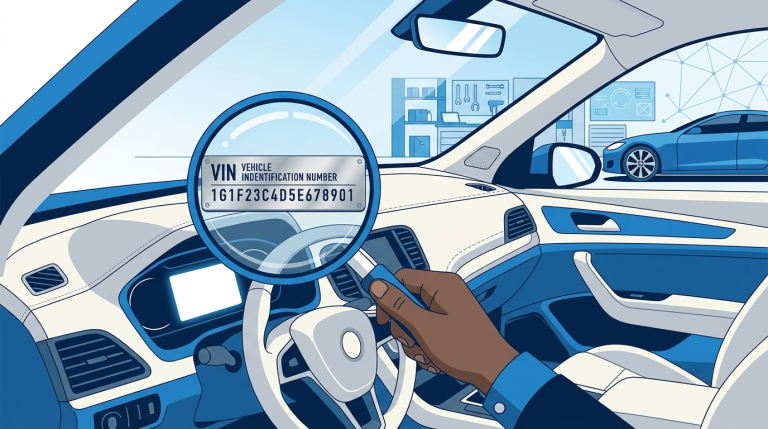
How to Read a VIN Number: Complete Decoder Guide
Every vehicle on the road carries a unique 17-character code that tells its entire life story — from where it was built to what’s under the hood. Learning how to read a VIN number is one of the most valuable skills any car buyer can have, yet most people have no idea what those letters and digits actually mean.
Whether you’re shopping for a used car, verifying a vehicle’s specs, or trying to confirm that a seller’s claims add up, decoding a VIN gives you hard facts that can’t be faked. In this complete guide, we’ll break down every position of a Vehicle Identification Number so you can read any VIN like a pro — no special tools required.
By the end, you’ll know exactly what each character reveals, where to find the VIN on any vehicle, and how to use that information to protect yourself from costly mistakes.
Table of Contents
- What Is a VIN Number?
- How to Read a VIN Number: The 17-Character Breakdown
- Positions 1–3: World Manufacturer Identifier (WMI)
- Positions 4–8: Vehicle Descriptor Section (VDS)
- Position 9: The Check Digit
- Positions 10–17: Vehicle Identifier Section (VIS)
- How to Decode a VIN Number Step by Step
- Where to Find the VIN on Any Vehicle
- Why Reading a VIN Matters Before Buying a Used Car
- Free vs. Paid VIN Decoding Tools
- Common VIN Reading Mistakes to Avoid
- Frequently Asked Questions
What Is a VIN Number?
A Vehicle Identification Number (VIN) is a standardized 17-character code assigned to every car, truck, SUV, and motorcycle manufactured since 1981. Think of it as a vehicle’s fingerprint — no two VINs are alike anywhere in the world.
The National Highway Traffic Safety Administration (NHTSA) mandates the VIN format under Federal Motor Vehicle Safety Standard No. 115. Before 1981, manufacturers used their own numbering systems, which is why older vehicles may have shorter or differently structured VINs.
A VIN contains only letters and numbers — but never the letters I, O, or Q, since they can be confused with the numbers 1 and 0. If you want to understand the basics of what a VIN reveals, our guide to VIN checks covers the fundamentals.
How to Read a VIN Number: The 17-Character Breakdown
Once you understand the structure, learning how to read a VIN number is surprisingly straightforward. Every VIN is divided into three distinct sections:
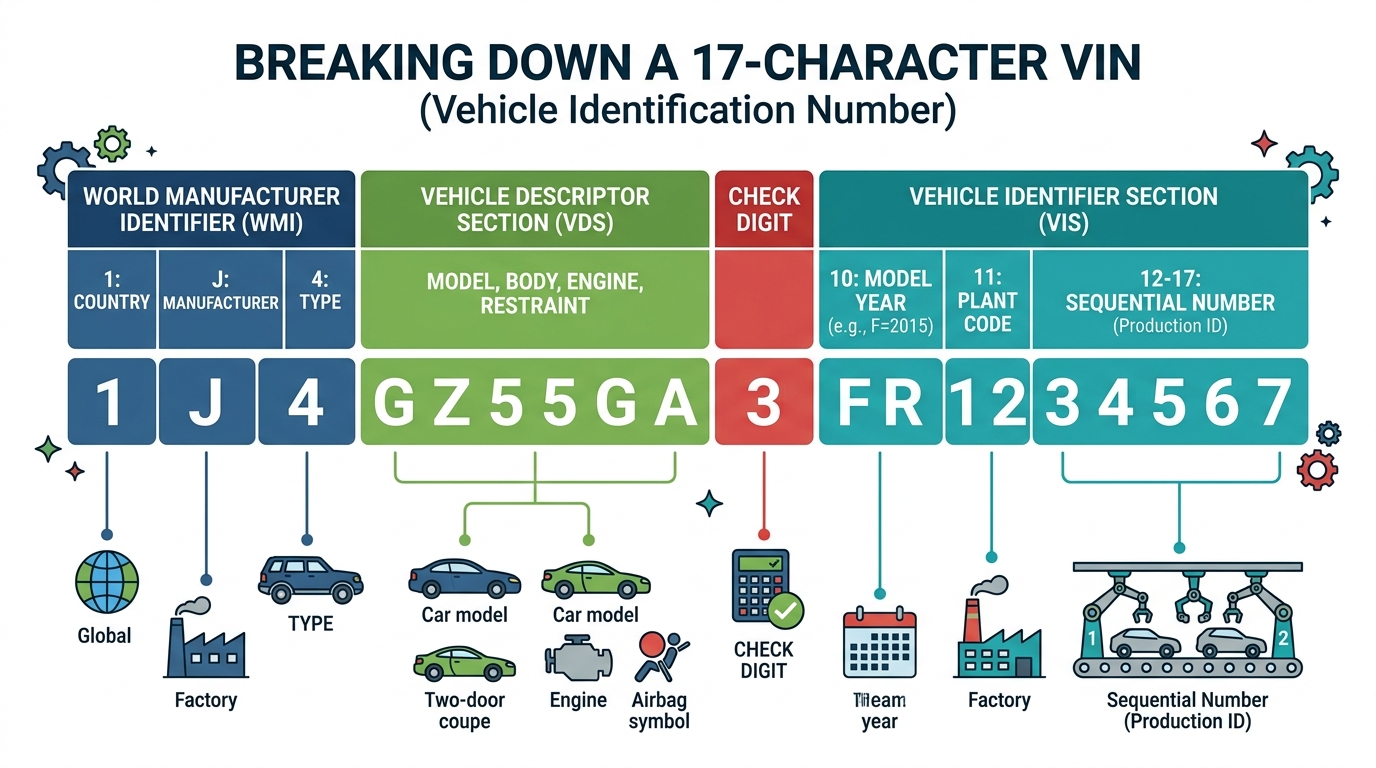
- Positions 1–3: World Manufacturer Identifier (WMI) — identifies the country, manufacturer, and vehicle type
- Positions 4–8: Vehicle Descriptor Section (VDS) — describes the vehicle’s model, body style, engine, and safety features
- Position 9: Check digit — a mathematical security code used to detect invalid VINs
- Positions 10–17: Vehicle Identifier Section (VIS) — identifies the model year, assembly plant, and unique production sequence
Let’s walk through each section in detail so you can decode any VIN you encounter.
Positions 1–3: World Manufacturer Identifier (WMI)
The first three characters of a VIN tell you where and by whom the vehicle was built.
Position 1: Country of Origin
The first character identifies the country (or region) where the vehicle was manufactured. Here are the most common codes:
- 1, 4, 5 — United States
- 2 — Canada
- 3 — Mexico
- J — Japan
- K — South Korea
- S — United Kingdom
- W — Germany
- Z — Italy
This is immediately useful when buying a used car. A “German” luxury brand might actually have been assembled in the U.S. or Mexico — and that can affect parts availability and resale value.
Positions 2–3: Manufacturer and Vehicle Type
The second character narrows down the manufacturer (e.g., “B” for BMW, “G” for General Motors, “T” for Toyota). The third character typically identifies the vehicle type or manufacturing division — such as passenger car, truck, or SUV.
For example, a VIN starting with 1G1 means a Chevrolet passenger car made in the United States, while JHM indicates a Honda (Acura) built in Japan.
Positions 4–8: Vehicle Descriptor Section (VDS)
This is where you learn the most about the actual vehicle. Positions 4 through 8 describe:
- Model and trim level
- Body style (sedan, coupe, SUV, convertible)
- Engine type and size
- Transmission type
- Restraint system (airbag configuration)
The exact meaning of each position varies by manufacturer, but the information is standardized enough that any VIN number lookup tool can decode it accurately. This section is especially valuable when verifying that a seller’s description matches the factory specs — if someone claims a car has a V8 but the VIN says V6, that’s a serious red flag.
Position 9: The Check Digit
Position 9 is unique — it’s not a vehicle descriptor but a mathematical validation code. The check digit is calculated using a specific formula applied to all other characters in the VIN. It exists for one purpose: to verify that the VIN hasn’t been altered or transcribed incorrectly.
This is one reason why VIN cloning and tampering are difficult (though not impossible). If even a single character is changed, the check digit won’t match, and the VIN will flag as invalid in any NMVTIS-connected database.
Positions 10–17: Vehicle Identifier Section (VIS)
Position 10: Model Year
The 10th character tells you the vehicle’s model year. This follows a rotating code system:
- A = 1980 / 2010
- B = 1981 / 2011
- J = 1988 / 2018
- K = 1989 / 2019
- L = 1990 / 2020
- M = 1991 / 2021
- N = 1992 / 2022
- P = 1993 / 2023
- R = 1994 / 2024
- S = 1995 / 2025
- T = 1996 / 2026
The cycle repeats every 30 years, but you can usually tell which era a vehicle belongs to based on other VIN characters and the vehicle itself. For used car shoppers, this is a quick way to verify that a car is actually the year the seller claims it is.
Position 11: Assembly Plant
The 11th character identifies the specific factory where the vehicle was assembled. Each manufacturer assigns its own plant codes. This can be useful for enthusiasts or buyers who prefer vehicles from specific production facilities known for higher quality standards.
Positions 12–17: Production Sequence Number
The final six characters are the vehicle’s unique serial number within that model year and plant. This is what makes every VIN truly one-of-a-kind. For collectors, a low production sequence number can sometimes add value.
How to Decode a VIN Number Step by Step
Ready to put your knowledge into practice? Here’s how to read a VIN number in five simple steps:
- Locate the VIN — Find the 17-character code on the vehicle (see locations below)
- Verify the length — A valid modern VIN is exactly 17 characters. No more, no less. If it’s shorter, the vehicle may predate 1981
- Check for invalid characters — Remember, VINs never contain I, O, or Q
- Read the WMI (positions 1–3) — Identify the country of origin and manufacturer
- Run it through a decoder — Use NHTSA’s free VIN decoder for basic factory specs, or use a comprehensive tool like VINCheckup to get the full vehicle history including accidents, title issues, and odometer records
While you can manually decode much of the VIN using the charts above, automated tools pull from manufacturer databases to give you precise details about trim packages, optional equipment, and safety ratings.
Where to Find the VIN on Any Vehicle
Before you can read a VIN, you need to find it. Here are the most common locations:
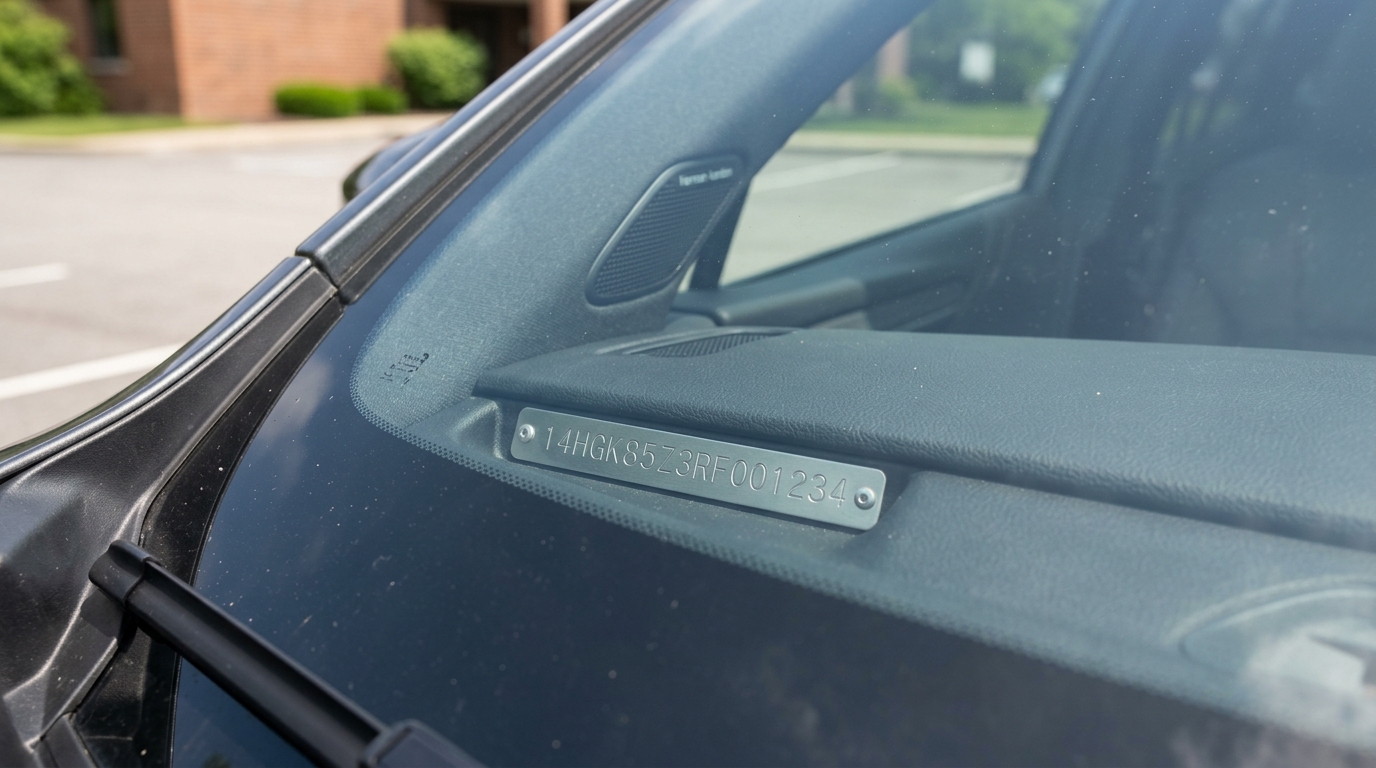
- Driver’s side dashboard — Look through the windshield at the base of the dashboard on the driver’s side. This is the easiest spot to check on a dealer lot
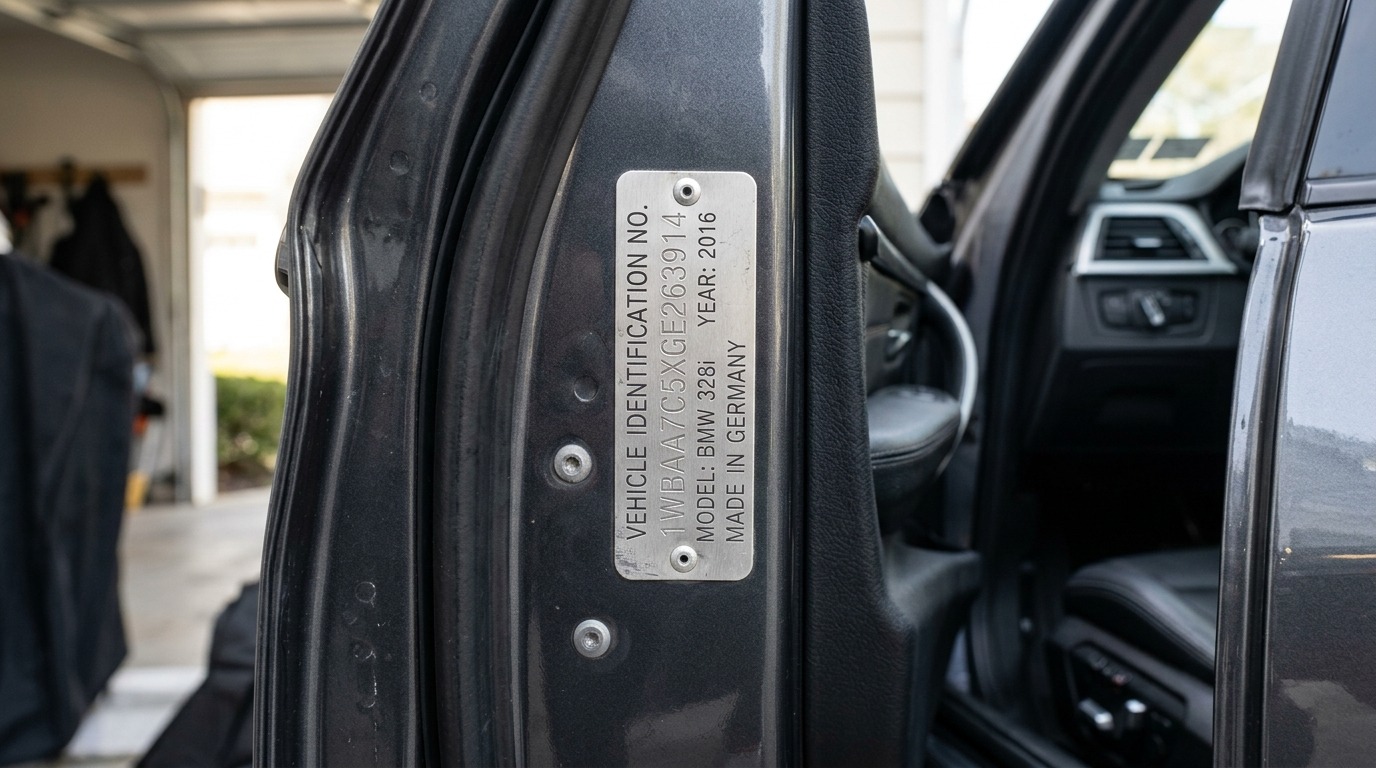
- Driver’s side door jamb — Open the driver’s door and look for a sticker on the door frame. This label also shows the tire pressure specs and paint code
- Vehicle title and registration — The VIN is printed on all ownership documents
- Insurance card — Your policy documents list the VIN
- Engine block — Usually stamped on the front of the engine (harder to access but useful for verification)
Pro tip for used car buyers: Always compare the VIN on the dashboard with the VIN on the door jamb and the title paperwork. If they don’t match, walk away immediately — mismatched VINs are a hallmark of VIN cloning and fraud.
Why Reading a VIN Matters Before Buying a Used Car
Understanding how to read a VIN number isn’t just an interesting skill — it’s a critical layer of protection when buying a used vehicle. Here’s what VIN decoding can help you uncover:
- Title problems: Salvage, rebuilt, or flood-damaged titles that sellers may try to hide
- Odometer fraud: According to NHTSA, odometer rollback affects more than 450,000 vehicles sold each year in the United States
- Factory specs verification: Confirm the engine, transmission, and trim level match the seller’s claims
- Recall status: Check whether the vehicle has open safety recalls that haven’t been addressed
- Theft records: Verify the car isn’t stolen or involved in insurance fraud
A quick VIN lookup can save you thousands of dollars and countless headaches. For a comprehensive vehicle history check, we recommend VINCheckup, which pulls data from NMVTIS, insurance databases, and state DMV records to give you the complete picture. You can also explore our free VIN check guide to understand what’s available at no cost.
Free vs. Paid VIN Decoding Tools
There are two tiers of VIN decoding tools available, and understanding the difference matters:
Free VIN Decoders
- NHTSA VIN Decoder: Provides factory specs — make, model, year, engine, body style, and safety equipment. Also shows open recall information
- Basic online tools: Many websites offer free VIN decoding that pulls the same NHTSA data
Free tools are great for verifying what a vehicle is, but they won’t tell you what happened to it.
Paid Vehicle History Reports
- Accident and damage history
- Title brand records (salvage, flood, lemon law buyback)
- Odometer readings over time
- Ownership history and registration data
- Service and maintenance records
For anyone serious about buying a used car, a paid report from a service like VINCheckup is well worth the investment. Our VINCheckup review breaks down exactly what you get and how it compares to alternatives.
Common VIN Reading Mistakes to Avoid
Even experienced buyers make these errors when trying to read a VIN number:
- Confusing similar characters: The number “0” and the letter “D” look similar on stamped VINs. The number “8” and letter “B” can also be tricky. Remember that I, O, and Q are never used
- Only checking one VIN location: Always verify the VIN in at least two spots on the vehicle. Criminals may replace the dashboard plate but forget the door jamb sticker
- Trusting the VIN alone: A VIN confirms factory specs and history, but it can’t tell you about current mechanical condition. Always pair your VIN research with a thorough physical inspection
- Ignoring partial VIN matches: Scammers sometimes alter just one or two digits. If anything about the VIN seems inconsistent, run the full 17 characters through a decoder
- Skipping the title comparison: The VIN on the vehicle must match the VIN on the title exactly. A single character difference means something is wrong
Frequently Asked Questions
How many characters are in a VIN number?
A standard VIN contains exactly 17 characters — a mix of letters and numbers. Vehicles manufactured before 1981 may have shorter VINs since the 17-character format wasn’t standardized until that year. The letters I, O, and Q are never used in a VIN to avoid confusion with the numbers 1 and 0.
Can I read a VIN number to find out if a car was in an accident?
The VIN itself doesn’t encode accident history, but you can use the VIN to pull a vehicle history report that includes accident and damage records. Services like VINCheckup search insurance claim databases and police records to reveal past incidents.
What does each position in a VIN number mean?
Positions 1–3 identify the manufacturer and country of origin. Positions 4–8 describe the vehicle’s attributes (model, engine, body style). Position 9 is a mathematical check digit. Position 10 indicates the model year. Position 11 identifies the assembly plant. Positions 12–17 are the unique production sequence number.
Is it safe to share my VIN number publicly?
Your VIN is semi-public information — it’s visible through your windshield, printed on insurance documents, and recorded in government databases. Sharing it generally carries low risk, but avoid posting it on social media where it could be paired with other personal information for identity theft or VIN cloning schemes.
How do I tell the model year from a VIN?
The 10th character of the VIN indicates the model year using a rotating alphabetical and numerical code. For example, “T” represents 2026 (and 1996), “S” represents 2025, and “R” represents 2024. You can cross-reference this character with a model year chart or simply run the full VIN through NHTSA’s free decoder tool.